Laser Level vs Laser Measure: Which Tool Do You Actually Need?
Two tools, one word — "laser" — and a lot of confused shopping baskets. This guide explains what a laser level does, what a laser measure does, and which one your project actually needs first.
TL;DR: A laser level projects a straight reference line so you can align, plumb and level things. A laser measure (laser distance meter) calculates how far away something is. They complement each other rather than compete: the level keeps work straight, the measure tells you the numbers. If you are kitting out for a self build or major renovation, most people need the measure first — dimensions and material quantities come before second-fix alignment.
What Is a Laser Level and What Does It Do?
A laser level projects a perfectly straight beam — horizontal, vertical, or both — across a surface so you can align, plumb, or grade with confidence. Whether you are hanging kitchen units, tiling a bathroom or setting out fence posts, it replaces spirit levels, string lines and a fair bit of guesswork.
Modern self-levelling cross-line and rotary models are accurate enough for interior fit-out work, and they shine on jobs where several things must sit on the same line: cabinets, dado rails, socket heights, suspended ceilings, pipe gradients, patio falls.
What a laser level does not do is tell you how long, wide or high anything is. It draws the line; it does not read the tape.
What Is a Laser Measure and What Does It Do?
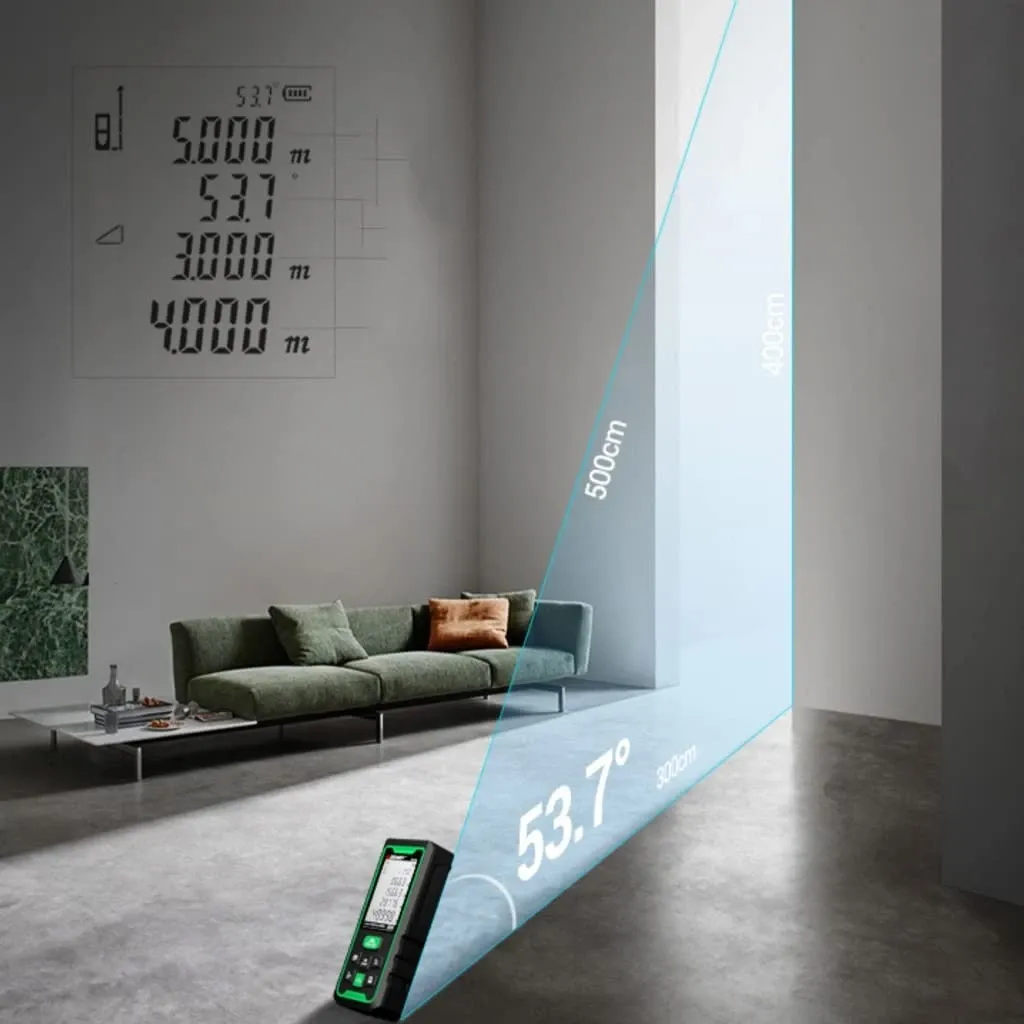
A laser measure (also called a laser distance meter or electronic distance meter) fires a pulse of light at a surface and calculates the distance from the reflection — a reading in under a second, accurate to ±2mm on professional units such as the CIGMAN 120m. It replaces the tape measure for room dimensions, ceiling heights, plot and boundary distances, and it calculates areas and volumes for you.
That makes it the quantity tool: how much flooring, how many boards, how much paint, whether the sofa fits. On a self build it earns its keep from the first site visit — measuring the plot and existing structures — long before anything needs aligning.
Laser Level vs Laser Measure at a Glance
| Laser level | Laser measure | |
|---|---|---|
| Job | Alignment — straight, plumb, level | Distance — length, area, volume, height |
| Output | A projected line or dot on the surface | A number on a backlit display |
| Typical tasks | Kitchen units, tiling, shelving, setting out walls, patio falls | Room dimensions, plot measuring, material quantities, checking drawings |
| Replaces | Spirit level, string line | Tape measure, notepad arithmetic |
| When you need it | Mostly during fit-out and finishing | From day one: planning, ordering, checking |
Comparing specific laser measure brands and prices instead? Our best laser measure UK comparison puts CIGMAN, Bosch, Leica and Huepar side by side.
Which Do You Need for Your Project?
If you are working through a self-build or renovation tool list and the budget will not stretch to everything at once, think about the order the jobs arrive in:
- Buying land or planning an extension? Laser measure — plot dimensions, existing room sizes and drawings checks are all distance work.
- Ordering materials? Laser measure — area mode turns two readings into square metres for flooring, plasterboard or paint, so you buy once instead of twice.
- First fix, stud walls, service runs? Both begin to matter: the measure for positions and lengths, a level if walls and rails must line up over distance.
- Kitchen fitting, tiling, shelving, finishing? Laser level — this is where projected lines save hours of spirit-level shuffling.
Most self builders end up owning both eventually. Starting with the measure is usually the right call: mis-measured dimensions cost money from the very first materials order, and a wrong order or a return delays the build in a way a wobbly shelf line does not.
Does CIGMAN Sell Laser Levels?
No — and it is worth being straight about that on a page like this. CIGMAN specialises in one tool done well: the CIGMAN 120m laser distance meter — 0.05m to 120m (393ft) range, ±2mm accuracy, area/volume/Pythagoras modes, USB Type-C charging and a backlit LCD, at £79.99 including VAT with free UK next-day delivery, 30-day returns and a 12-month warranty. If a laser level is what your project needs, the established names in that category (Bosch, DeWalt and others) are the sensible place to look; if it is distances and quantities you need, that is exactly what the CIGMAN is for.
CIGMAN 120m Laser Distance Meter
120m range · ±2mm accuracy · USB Type-C · area/volume/Pythagoras · 12-month warranty
View Product — £79.99Frequently Asked Questions
Can a laser measure replace a laser level?
No. A laser measure tells you how far, not whether something is straight or level. If you are hanging kitchen units or setting out a stud wall, you need a projected reference line — that is the level's job.
Can a laser level measure distance?
Generally not. Most cross-line and rotary levels only project a line or dot; they do not read distances. A handful of premium units combine both functions, but at prices well above buying two dedicated tools.
Which should a self builder buy first?
Usually the laser measure. Plot dimensions, room sizes, material quantities and progress checks against drawings all start with distances — those needs arrive before second fix, which is where a level earns its keep.
Does CIGMAN make a laser level?
No. CIGMAN specialises in laser distance meters — the CIGMAN 120m offers 120m range, ±2mm accuracy and USB-C charging at £79.99. For a laser level, the established names in that category are the sensible place to look.
Ready to upgrade your accuracy with CIGMAN?
Upgrade Your Toolkit — £79.99